

PEARL
IN
ACTION
The PEARL Framework
Exploring occupation in context, meaning, and relationship
The PEARL framework supports occupational therapists to explore how a person’s life is shaped by multiple interacting influences, rather than a single presenting difficulty.
Rather than asking “what is wrong?”, PEARL is oriented toward understanding:
- How a person is experiencing themselves and their world
- What supports or constrains engagement in everyday life
- How meaning, safety, identity, and rhythm shape occupation over time
PEARL holds these influences together, allowing complexity to remain visible without being reduced or simplified.
It is a model concerned with coherence, not categorisation.
What The PEARL Framework explores
PEARL explores how people live, adapt, and participate across their everyday worlds.
It attends to:
- The conditions that shape a person’s capacity to engage
- The environments and systems they move within
- The relationships that influence safety, confidence, and choice
- The roles, rhythms, and expectations organising daily life
- The meanings attached to past and present occupations
These elements are not treated separately.
PEARL is interested in how they interact, overlap, and shift and what this means for occupational engagement.
A PEARL illustration: holding complexity as a whole
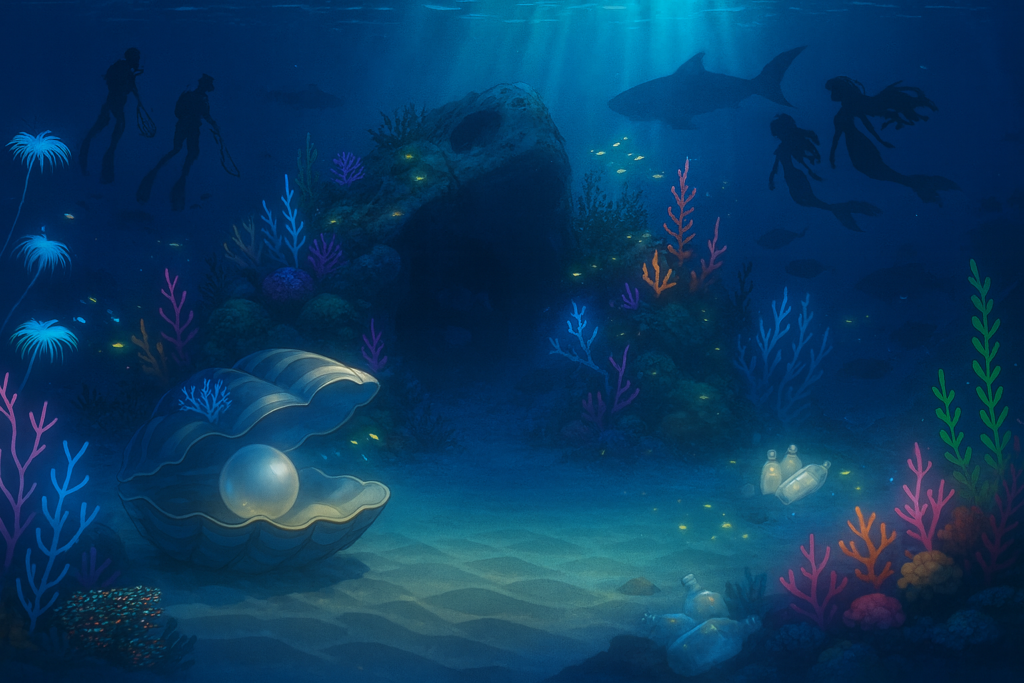
About This Image
This image was created as a visual reflection using the PEARL Model. It does not represent a single event or diagnosis, but a way of understanding lived experience as layered, dynamic, and coherent.
Within the image, multiple elements coexist.
The divers represent both threat and possibility. They carry the weight of past experiences where people were unsafe or intrusive, yet they also symbolise the potential for new relationships, including support, care, and restoration. The same figures can evoke fear and hope, reflecting the ambivalence that often accompanies connection following adversity.
The mermaids reflect experiences of friendship and relational support. They are not positioned as rescuers, but as companions, present, alongside, and mutually engaged rather than overpowering.
The shark represents past threat. It reflects historical trauma that continues to shape perception and vigilance, even when the danger itself is no longer immediate. Its presence in the background acknowledges that the past still exists, without allowing it to dominate the whole scene.
At the centre, the pearl within the shell symbolises resilience and value that has formed over time. The shell is not fully open. This reflects ongoing self-development; growth that is real, but still protected. PEARL does not assume readiness or exposure; it allows strength and vulnerability to coexist.
The dark cave represents a place of retreat and restoration. It is somewhere to hide, regroup, and feel held; not as avoidance, but as a necessary form of self-protection. Within PEARL, safety and withdrawal are understood as adaptive responses, not deficits.
The glowing light moving through the water reflects change over time. It signals movement from what once felt like total darkness toward greater clarity and possibility, without implying that everything is resolved or complete.
Elements of discarded rubbish are visible across the sea floor. These reflect imbalances in life rhythm, periods of overload, disruption, or neglect. They are present, but not overwhelming. Alongside them is a steady, rhythmic sea, suggesting predictability and continuity that supports regulation and participation.
Crucially, the image as a whole does not appear fragmented.
Although it contains threat, loss, protection, growth, support, and imbalance, these elements are held within a single coherent landscape. Nothing has been erased, and nothing has destroyed the beauty of what remains. The past has shaped the environment, but it has not undone what is still alive, meaningful, and growing.
This is central to how PEARL works.
Rather than separating experiences into “good” and “bad,” or focusing on removing unwanted parts, PEARL supports an understanding of how all elements of a life can be acknowledged, integrated, and held with acceptance, allowing a person to recognise their own journey without being defined by any single aspect of it.