Please note: This is the full recording of the live Lumina Springs workshop held on the 18th of June 2026, now available to watch on demand.
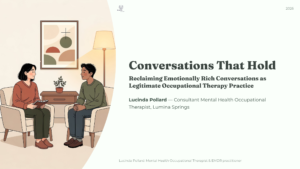
Some of the most meaningful occupational therapy work happens in moments that do not always look like intervention in the traditional sense.
A conversation that helps someone make sense of their experience. A moment of feeling genuinely understood. A shared reflection that restores hope, possibility or direction. Yet these are often the very moments occupational therapists find hardest to articulate, justify or confidently claim as occupational therapy.
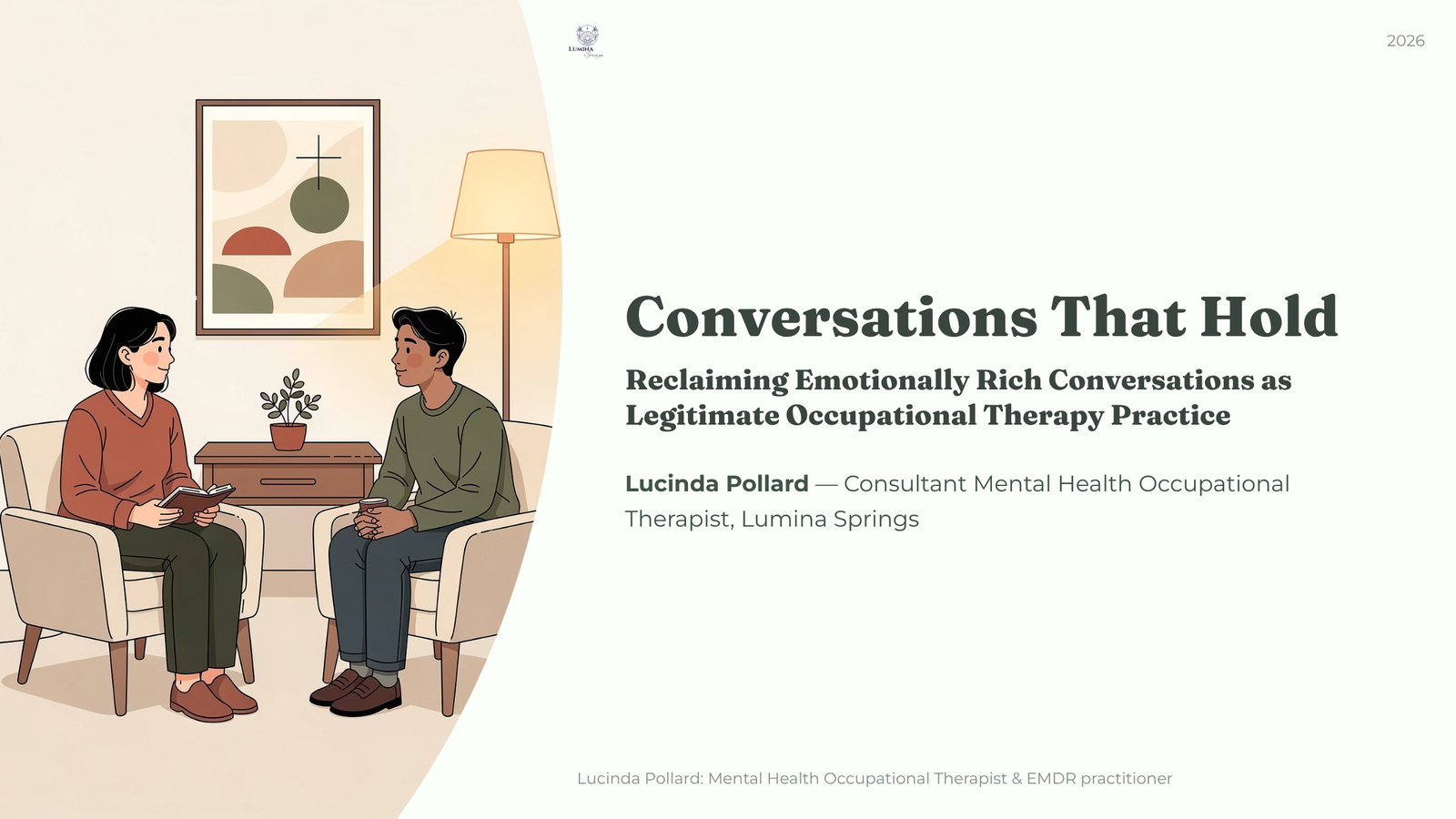
This workshop explores how emotionally rich conversations can be understood as legitimate, skilled and deeply occupational practice.
Together, we will examine how conversation itself can function as an occupation, shaped by context, purpose, meaning and participation. We will explore the role of occupational presence, relational reasoning and therapeutic use of self, while remaining grounded in occupational therapy identity and professional reasoning.
Rather than borrowing language from other professions or feeling the need to defend relational work, this training focuses on strengthening confidence in what occupational therapists uniquely bring to emotionally complex spaces.
Drawing upon occupational therapy theory, occupational science, the Intentional Relationship Model, narrative and meaning-making perspectives, and psychologically informed practice, participants will be invited to think critically about the role of conversation within occupational therapy and how these interactions can influence participation, identity, belonging and everyday life.
Throughout the workshop we will explore:
- Why emotionally rich conversations can feel difficult to legitimise within occupational therapy
- How conversation can be understood as an occupation and a form of participation
- The relationship between conversation, identity, meaning-making and occupational engagement
- What may be happening within conversations that support change, understanding and participation
- How to remain occupational while working in emotionally complex and relational spaces
- Occupational presence, relational reasoning and therapeutic use of self
- Practical ways of describing, documenting and communicating this work with confidence
By the end of the workshop, participants will be able to:
- Describe how conversation can be understood through an occupational lens
- Recognise the relationship between participation, identity, meaning, belonging and emotionally rich conversations
- Explain how occupational therapists can remain occupational while working in relational and emotional spaces
- Identify occupational themes within therapeutic conversations
- Apply occupational reasoning to emotionally complex clinical situations
- Describe and document conversational interventions using occupational language and concepts
This workshop is particularly relevant for occupational therapists working in mental health, neurodivergence, trauma-informed services, education, community practice, independent practice and any setting where conversation, relationship and emotional complexity are central to participation and change.
Duration: Approximately 3 hours
Presenter: Lucinda Pollard
Consultant Mental Health Occupational Therapist